It’s a sight that makes every rug owner's heart skip a beat: a single, rogue loop of yarn standing tall and proud above the otherwise perfect surface of your area rug. This "snag" or "sprout" can be caused by anything from a pet's claw to the leg of a dragged chair or an overly aggressive vacuum cleaner. Your immediate, almost primal, instinct is to grab that little loop and give it a good, satisfying pull.
Stop. Whatever you do, do not pull that thread.
Pulling on a snag is the single worst thing you can do, and it can cause permanent damage to your beloved rug. The good news is that fixing a snag is one of the easiest and quickest DIY rug repairs you can perform. This is your simple, step-by-step guide to fixing a snagged loop the right way, preserving the beauty and integrity of your area rugs.

Why You Should Never, Ever Pull a Snag
To understand why pulling is so destructive, you need to understand how your rug is made.
-
In a Loop-Pile Rug (like a Berber): The surface is made of continuous, uncut loops of yarn. If you pull on a single snagged loop, you can cause a "run," effectively unraveling an entire row of loops, much like a snag in a sweater. This can create a long, ugly bald patch that is very difficult to repair.
-
In a Cut-Pile Rug: The pile is made of individual strands of yarn knotted to the rug's foundation. Pulling on a single sprout can loosen or completely pull out the entire knot, creating a small hole in the rug's design.
In either case, pulling turns a minor cosmetic issue into a significant structural problem.
The 2-Step Fix: Your Simple Toolkit
Fixing a snag requires no special skills and only a couple of basic household items.
What You'll Need:
-
A pair of small, sharp scissors (like craft or nail scissors)
-
A knitting needle, a crochet hook, or a simple toothpick
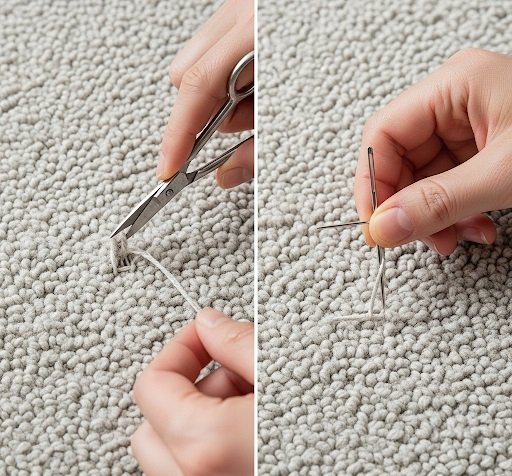
Step 1: The Snip
This is the most important step. Take your sharp scissors and carefully snip the snagged loop so that the ends are even with the height of the rest of the rug's pile. Just trim the part that is sticking up. For most low-pile area rugs, this single step is often all you need to do. The trimmed ends will blend back into the surface, and the snag will be virtually invisible.
Step 2: The Tuck (Optional, for a Perfect Finish)
After snipping, you may have two tiny, cut ends of yarn that are still slightly visible. For a flawless finish, you can gently tuck these ends back down into the rug's foundation.
-
How to do it: Use the tip of your knitting needle, crochet hook, or toothpick to gently push and poke the trimmed ends down into the base of the pile, nestled among the surrounding fibers. This will hide the cut ends completely, leaving a seamless surface.
Prevention: The Best Cure
The easiest way to deal with snags is to prevent them from happening in the first place.
-
Vacuum Correctly: The number one cause of snags is an overly aggressive vacuum. Always use a suction-only setting on your area rugs, especially on loop-pile or shag styles. Turn off the beater bar, as its spinning bristles are notorious for catching and pulling loops.
-
Trim Pet Nails: Keep your cat's and dog's nails trimmed to reduce the risk of them snagging the fibers.
-
Lift, Don't Drag: When moving furniture, always lift it completely off the rug instead of dragging it across the surface.
When to Call a Professional
While this DIY fix is perfect for minor, everyday snags, some situations are best left to an expert. If you have a very large run in a Berber carpet, a significant hole in a hand-knotted rug, or if the rug is a valuable antique, do not attempt a home repair.
A professional area rug cleaning and repair service has the specialized tools and expertise to re-weave damaged sections and perform invisible repairs, restoring the value and beauty of your piece.
Conclusion: A Simple Fix for a Common Problem
A snagged loop is a common and thankfully minor issue in the life of a rug. By resisting the urge to pull and following these simple snip-and-tuck steps, you can easily maintain the beautiful, smooth surface of your rug. A little bit of care and the right technique are all it takes to keep your area rugs looking pristine for years to come.
C'est un spectacle qui fait battre le cœur de tout propriétaire de tapis : une seule boucle de fil rebelle qui se dresse fièrement au-dessus de la surface autrement parfaite de votre tapis. Cet « accroc » ou « pousse » peut être causé par n'importe quoi, de la griffe d'un animal de compagnie au pied d'une chaise traînée ou à un aspirateur trop agressif. Votre instinct immédiat, presque primaire, est d'attraper cette petite boucle et de tirer un bon coup satisfaisant.
Arrêtez. Quoi que vous fassiez, ne tirez pas sur ce fil.
Tirer sur un accroc est la pire chose que vous puissiez faire, et cela peut causer des dommages permanents à votre tapis bien-aimé. La bonne nouvelle est que réparer un accroc est l'une des réparations de tapis les plus faciles et les plus rapides que vous puissiez effectuer vous-même. Voici votre guide simple, étape par étape, pour réparer une boucle accrochée de la bonne manière, en préservant la beauté et l'intégrité de vos tapis.
Pourquoi vous ne devriez jamais, au grand jamais, tirer sur un accroc
Pour comprendre pourquoi tirer est si destructeur, vous devez comprendre comment votre tapis est fabriqué.
-
Dans un tapis à boucles (comme un Berbère) : La surface est faite de boucles de fil continues et non coupées. Si vous tirez sur une seule boucle accrochée, vous pouvez provoquer une « échelle », en défaisant efficacement toute une rangée de boucles, un peu comme un accroc dans un pull. Cela peut créer une longue et vilaine zone chauve très difficile à réparer.
-
Dans un tapis à velours coupé : Le velours est composé de brins de fil individuels noués à la base du tapis. Tirer sur une seule pousse peut desserrer ou arracher complètement tout le nœud, créant un petit trou dans le dessin du tapis.
Dans les deux cas, tirer transforme un problème cosmétique mineur en un problème structurel important.
La réparation en 2 étapes : Votre trousse à outils simple
Réparer un accroc ne nécessite aucune compétence particulière et seulement quelques articles ménagers de base.
Ce dont vous aurez besoin :
-
Une paire de petits ciseaux bien aiguisés (comme des ciseaux de bricolage ou à ongles)
-
Une aiguille à tricoter, un crochet ou un simple cure-dent
Étape 1 : La coupe
C'est l'étape la plus importante. Prenez vos ciseaux bien aiguisés et coupez soigneusement la boucle accrochée de manière à ce que les extrémités soient au même niveau que le reste du velours du tapis. Coupez simplement la partie qui dépasse. Pour la plupart des tapis à velours ras, cette seule étape suffit souvent. Les extrémités coupées se fondront dans la surface et l'accroc sera pratiquement invisible.
Étape 2 : Le rentré (Facultatif, pour une finition parfaite)
Après la coupe, il se peut que vous ayez deux minuscules extrémités de fil coupées qui sont encore légèrement visibles. Pour une finition impeccable, vous pouvez les rentrer doucement dans la base du tapis.
-
Comment faire : Utilisez la pointe de votre aiguille à tricoter, de votre crochet ou de votre cure-dent pour pousser et enfoncer doucement les extrémités coupées dans la base du velours, nichées parmi les fibres environnantes. Cela cachera complètement les extrémités coupées, laissant une surface sans défaut.
Prévention : Mieux vaut prévenir que guérir
Le moyen le plus simple de gérer les accrocs est de les empêcher de se produire.
-
Passez l'aspirateur correctement : La cause numéro un des accrocs est un aspirateur trop agressif. Utilisez toujours un réglage d'aspiration uniquement sur vos tapis, en particulier sur les styles à boucles ou à longs poils. Désactivez la brosse rotative, car ses poils tournants sont connus pour attraper et tirer les boucles.
-
Coupez les griffes des animaux : Gardez les griffes de votre chat et de votre chien coupées pour réduire le risque qu'elles accrochent les fibres.
-
Soulevez, ne traînez pas : Lorsque vous déplacez des meubles, soulevez-les toujours complètement du tapis au lieu de les traîner sur la surface.
Quand faire appel à un professionnel
Bien que cette réparation maison soit parfaite pour les accrocs mineurs du quotidien, certaines situations doivent être laissées à un expert. Si vous avez une très grande échelle dans un tapis berbère, un trou important dans un tapis noué à la main, ou si le tapis est une antiquité de valeur, n'essayez pas de le réparer vous-même.
Un service professionnel de nettoyage et de réparation de tapis dispose des outils et de l'expertise spécialisés pour retisser les sections endommagées et effectuer des réparations invisibles, restaurant ainsi la valeur et la beauté de votre pièce.
Conclusion : Une solution simple à un problème courant
Une boucle accrochée est un problème courant et heureusement mineur dans la vie d'un tapis. En résistant à l'envie de tirer et en suivant ces simples étapes de coupe et de rentré, vous pouvez facilement maintenir la belle surface lisse de votre tapis. Un peu de soin et la bonne technique suffisent pour que vos tapis restent impeccables pendant des années.
Es un espectáculo que hace que el corazón de todo propietario de una alfombra dé un vuelco: un único bucle de hilo rebelde que se yergue orgulloso sobre la superficie por lo demás perfecta de tu alfombra. Este «enganchón» o «brote» puede ser causado por cualquier cosa, desde la garra de una mascota hasta la pata de una silla arrastrada o una aspiradora demasiado agresiva. Tu instinto inmediato, casi primario, es agarrar ese pequeño bucle y darle un buen y satisfactorio tirón.
Detente. Hagas lo que hagas, no tires de ese hilo.
Tirar de un enganchón es lo peor que puedes hacer, y puede causar daños permanentes a tu querida alfombra. La buena noticia es que arreglar un enganchón es una de las reparaciones de alfombras más fáciles y rápidas que puedes hacer tú mismo. Aquí tienes tu guía sencilla, paso a paso, para arreglar un bucle enganchado de la manera correcta, preservando la belleza y la integridad de tus alfombras.
Por qué nunca, jamás, deberías tirar de un enganchón
Para entender por qué tirar es tan destructivo, necesitas comprender cómo está hecha tu alfombra.
-
En una alfombra de bucle (como una bereber): La superficie está hecha de bucles de hilo continuos y sin cortar. Si tiras de un solo bucle enganchado, puedes provocar una «carrera», deshaciendo eficazmente toda una fila de bucles, muy parecido a un enganchón en un suéter. Esto puede crear una calva larga y fea muy difícil de reparar.
-
En una alfombra de pelo cortado: El pelo está compuesto por hebras de hilo individuales anudadas a la base de la alfombra. Tirar de un solo brote puede aflojar o arrancar por completo todo el nudo, creando un pequeño agujero en el diseño de la alfombra.
En cualquier caso, tirar convierte un problema cosmético menor en un problema estructural importante.
La reparación en 2 pasos: Tu sencillo kit de herramientas
Arreglar un enganchón no requiere ninguna habilidad especial y solo un par de artículos domésticos básicos.
Lo que necesitarás:
-
Un par de tijeras pequeñas y afiladas (como las de manualidades o de uñas)
-
Una aguja de tejer, un ganchillo o un simple palillo de dientes
Paso 1: El corte
Este es el paso más importante. Coge tus tijeras afiladas y corta con cuidado el bucle enganchado para que los extremos queden al mismo nivel que el resto del pelo de la alfombra. Simplemente recorta la parte que sobresale. Para la mayoría de las alfombras de pelo corto, este único paso suele ser suficiente. Los extremos cortados se mezclarán con la superficie y el enganchón será prácticamente invisible.
Paso 2: El remetido (Opcional, para un acabado perfecto)
Después de cortar, es posible que tengas dos minúsculos extremos de hilo cortados que todavía sean ligeramente visibles. Para un acabado impecable, puedes remeterlos suavemente en la base de la alfombra.
-
Cómo hacerlo: Usa la punta de tu aguja de tejer, ganchillo o palillo de dientes para empujar y meter suavemente los extremos cortados en la base del pelo, entre las fibras circundantes. Esto ocultará por completo los extremos cortados, dejando una superficie sin costuras.
Prevención: Más vale prevenir que curar
La forma más fácil de lidiar con los enganchones es evitar que ocurran en primer lugar.
-
Aspira correctamente: La causa número uno de los enganchones es una aspiradora demasiado agresiva. Utiliza siempre un ajuste de solo succión en tus alfombras, especialmente en los estilos de bucle o de pelo largo. Desactiva la barra batidora, ya que sus cerdas giratorias son famosas por enganchar y tirar de los bucles.
-
Corta las uñas de las mascotas: Mantén las uñas de tu gato y de tu perro cortas para reducir el riesgo de que enganchen las fibras.
-
Levanta, no arrastres: Al mover los muebles, levántalos siempre por completo de la alfombra en lugar de arrastrarlos por la superficie.
Cuándo llamar a un profesional
Aunque este arreglo casero es perfecto para los enganchones menores del día a día, algunas situaciones es mejor dejarlas en manos de un experto. Si tienes una carrera muy grande en una alfombra bereber, un agujero importante в una alfombra anudada a mano, o si la alfombra es una antigüedad de valor, no intentes una reparación en casa.
Un servicio profesional de limpieza y reparación de alfombras dispone de las herramientas y la experiencia especializadas para retejer las secciones dañadas y realizar reparaciones invisibles, restaurando así el valor y la belleza de tu pieza.
Conclusión: Una solución sencilla para un problema común
Un bucle enganchado es un problema común y afortunadamente menor en la vida de una alfombra. Al resistir la tentación de tirar y seguir estos sencillos pasos de cortar y remeter, puedes mantener fácilmente la hermosa superficie lisa de tu alfombra. Un poco de cuidado y la técnica adecuada es todo lo que se necesita para que tus alfombras luzcan impecables durante años.